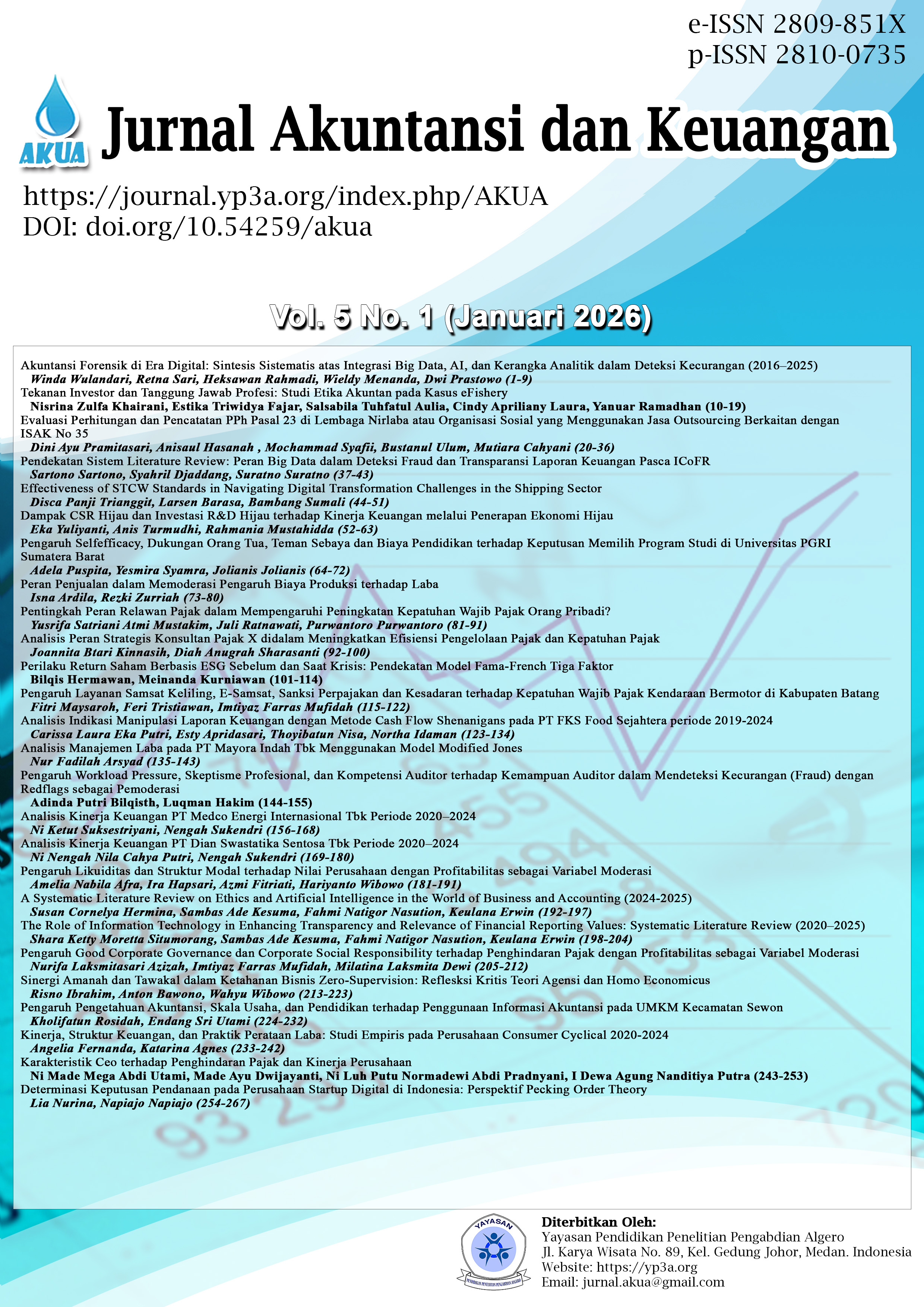
Determinasi Keputusan Pendanaan pada Perusahaan Startup Digital di Indonesia: Perspektif Pecking Order Theory
DOI:
https://doi.org/10.54259/akua.v5i1.7072Keywords:
Digital Startups, Financing Decisions, Pecking Order Theory, Information Asymmetry, Multinomial LogitAbstract
This study aims to analyze the determinants of financing decisions in Indonesian digital startups within the framework of the Pecking Order Theory (POT). The theory predicts a financing preference order starting from internal funds, followed by debt and equity. However, the distinctive characteristics of digital startups—such as the dominance of intangible assets, volatile cash flows, and rapid scaling requirements—may alter this hierarchy. This research employs an explanatory quantitative design using secondary data and purposive sampling of startups with verifiable information on founding year, firm scale, and financing history. Financing decisions are classified into internal financing, debt, and equity, and analyzed using a multinomial logit model. The main explanatory variables include firm size, age, growth stage, business risk, asset tangibility, internal funding strength, financing deficit, and prior funding experience, with subsector and year controls. The results indicate that stronger internal funds significantly reduce the likelihood of external financing, while financing deficits increase the probability of using both debt and equity. Firm size enhances access to external financing, whereas firm age and asset tangibility are more closely associated with debt financing. In contrast, the scaling stage, higher risk levels, and previous funding records tend to drive a preference for equity over debt. These findings suggest that POT applies conditionally to Indonesian digital startups, where direct transitions from internal financing to equity are more prevalent during rapid growth phases.
Downloads
References
Bhattacharyya, J., & Subrahmanya, M. H. B. (2024). Determinants of a digital start-up’s access to VC financing in India: A signaling theory perspective. Technological Forecasting and Social Change, 207, 123631. https://doi.org/10.1016/j.techfore.2024.123631 (Semantic Scholar)
Ferrucci, E., Guida, R., & Meliciani, V. (2021). Financial constraints and the growth and survival of innovative start-ups: An analysis of Italian firms. European Financial Management, 27(2), 364–386. https://doi.org/10.1111/eufm.12277 (Wiley Online Library)
Fulghieri, P., García, D., & Hackbarth, D. (2020). Asymmetric Information and the Pecking (Dis)Order. Review of Finance, 24(5), 961–996. https://doi.org/10.1093/rof/rfaa005 (OUP Academic)
Giraudo, E., Giudici, G., & Grilli, L. (2019). Entrepreneurship policy and the financing of young innovative companies: Evidence from the Italian Startup Act. Research Policy, 48(9), 103801. https://doi.org/10.1016/j.respol.2019.05.010 (ScienceDirect)
Guizani, M. (2020). Testing the pecking order theory of capital structure: The case of Islamic financing modes. Future Business Journal, 6(1). https://doi.org/10.1186/s43093-020-00042-9 (Springer Nature Link)
Hechavarría, D. M., Matthews, C. H., & Reynolds, P. D. (2016). Does start-up financing influence start-up speed? Evidence from the panel study of entrepreneurial dynamics. Small Business Economics, 46(1), 137–167. https://doi.org/10.1007/s11187-015-9680-y (IDEAS/RePEc)
Hogan, T., Hutson, E., & Drnevich, P. (2017). Drivers of External Equity Funding in Small High-Tech Ventures. Journal of Small Business Management, 55(2), 236–253. https://doi.org/10.1111/jsbm.12270 (IDEAS/RePEc)
Kedzior, M., Grabinska, B., Grabinski, K., & Kedzior, D. (2020). Capital Structure Choices in Technology Firms: Empirical Results from Polish Listed Companies. Journal of Risk and Financial Management, 13(9), 221. https://doi.org/10.3390/jrfm13090221 (MDPI)
Kleinert, S., Volkmann, C., & Grünhagen, M. (2020). Third-party signals in equity crowdfunding: the role of prior financing. Small Business Economics, 54. https://doi.org/10.1007/s11187-018-0125-2 (Springer Nature Link)
Ko, E.-J., & McKelvie, A. (2018). Signaling for more money: The roles of founders’ human capital and investor prominence in resource acquisition across different stages of firm development. Journal of Business Venturing, 33(4), 438–454. https://doi.org/10.1016/j.jbusvent.2018.03.001 (ScienceDirect)
Narayan, S. W. (2019). Does FinTech matter for Indonesia’s economic growth? Bulletin of Monetary Economics and Banking, 22(4), 437–456. https://doi.org/10.21098/bemp.v22i4.1237 (bulletin.bmeb-bi.org)
Siqueira, A. C. O., Mariano, S., & Moraes, G. H. S. M. (2018). A longitudinal comparison of capital structure between young for-profit social and commercial enterprises. Journal of Business Venturing, 33(2), 225–240. https://doi.org/10.1016/j.jbusvent.2017.12.006 (ScienceDirect)
Sulistianingsih, P., (et al.) (2023). Firm size sensitivity in financing decisions: evidence from SMEs (pecking order perspective). Cogent Economics & Finance, 11(1). https://doi.org/10.1080/23311975.2023.2174477 (IDEAS/RePEc)
Walthoff-Borm, X., Schwienbacher, A., & Vanacker, T. (2018). Equity crowdfunding: First resort or last resort? Journal of Business Venturing, 33(4), 513–533. https://doi.org/10.1016/j.jbusvent.2018.04.001 (biblio.ugent.be)
Brahmana, R. K., Setiawan, D., Lau, E., & Kontesa, M. (2024). Do the characteristics of startup founders matter for funding performance? Journal of Indonesian Economy and Business, 39(3), 328–346. https://doi.org/10.22146/jieb.v39i3.11841 (Jurnal Universitas Gadjah Mada)
Butticè, V., Colombo, M. G., & Rovelli, P. (2024). Venture capital and the delegation of decision authority in startups: An exploratory study. Journal of Industrial and Business Economics, 51(4), 893–923. https://doi.org/10.1007/s40812-024-00313-4 (Springer Nature Link)
Frimanslund, T., Kwiatkowski, G., & Oklevik, O. (2023). The role of finance in the literature of entrepreneurial ecosystems. European Planning Studies, 31(2), 372–391. https://doi.org/10.1080/09654313.2022.2055962 (IDEAS/RePEc)
Rosa, M. C. W., Sukoharsono, E. G., & Saraswati, E. (2019). The role of venture capital on start-up business development in Indonesia. Journal of Accounting and Investment, 20(1), 55–74. https://doi.org/10.18196/jai.2001108 (Journal UMY)
Suryono, R. R., Budi, I., & Purwandari, B. (2021). Detection of fintech P2P lending issues in Indonesia. Heliyon, 7(4), e06782. https://doi.org/10.1016/j.heliyon.2021.e06782 (ScienceDirect)
Al Haddar, S. Z., & Rahadiyan, I. (2021). The regulation of disclosure principle in equity crowdfunding (A comparison between Indonesia and United States of America). Mimbar Hukum, 33(2), 436–464. https://doi.org/10.22146/mh.v33i2.2285
Brahmana, R. K., Setiawan, D., Lau, E., & Kontesa, M. (2024). Do the characteristics of startup founders matter for funding performance? Journal of Indonesian Economy and Business, 39(3), 328–346. https://doi.org/10.22146/jieb.v39i3.11841
Butticè, V., Colombo, M. G., & Rovelli, P. (2024). Venture capital and the delegation of decision authority in startups: An exploratory study. Journal of Industrial and Business Economics, 51(4), 893–923. https://doi.org/10.1007/s40812-024-00313-4
Frimanslund, T., Tocher, N., & Zacharakis, A. (2023). The role of finance in the literature of entrepreneurial ecosystems: A systematic review. European Planning Studies, 31(9), 1788–1814. https://doi.org/10.1080/09654313.2022.2055962
Hoque, M. M. (2024). Crowdfunding for innovation: A comprehensive empirical review. Future Business Journal, 10, 102. https://doi.org/10.1186/s43093-024-00387-5
Lehnertz, N., Plagmann, C., & Lutz, E. (2022). Why deep pockets make great borrowers: An empirical analysis of venture loans. Journal of Business Economics, 92(9), 1431–1453. https://doi.org/10.1007/s11573-022-01084-x
Rosa, M. C. W., Sukoharsono, E. G., & Saraswati, E. (2019). The role of venture capital on start-up business development in Indonesia. Journal of Accounting and Investment, 20(1), 55–74. https://doi.org/10.18196/jai.2001108
Sudarwanto, A. S., Kharisma, D. B., & Cahyaningsih, D. T. (2025). Problems and oversight of securities crowdfunding in Indonesia: Learning from leading countries. Law and Financial Markets Review. https://doi.org/10.1080/17521440.2025.2569314
Suryono, R. R., Budi, I., & Purwandari, B. (2021). Detection of fintech P2P lending issues in Indonesia. Heliyon, 7(4), e06782. https://doi.org/10.1016/j.heliyon.2021.e06782
Taglialatela, J., & Mina, A. (2024). Innovation, asymmetric information and the capital structure of new firms. Economics of Innovation and New Technology, 33(7), 955–978. https://doi.org/10.1080/10438599.2023.2265821
Downloads
Published
How to Cite
Issue
Section
License
Copyright (c) 2025 Lia Nurina, Napiajo Napiajo

This work is licensed under a Creative Commons Attribution 4.0 International License.
Hak cipta pada setiap artikel adalah milik penulis.
Penulis mengakui bahwa AKUA (Jurnal Akuntansi dan Keuangan) sebagai publisher yang mempublikasikan pertama kali dengan lisensi Creative Commons Attribution 4.0 International License.
Penulis dapat memasukan tulisan secara terpisah, mengatur distribusi non-ekskulif dari naskah yang telah terbit di jurnal ini kedalam versi yang lain, seperti: dikirim ke respository institusi penulis, publikasi kedalam buku, dan lain-lain. Dengan mengakui bahwa naskah telah terbit pertama kali pada AKUA (Jurnal Akuntansi dan Keuangan).