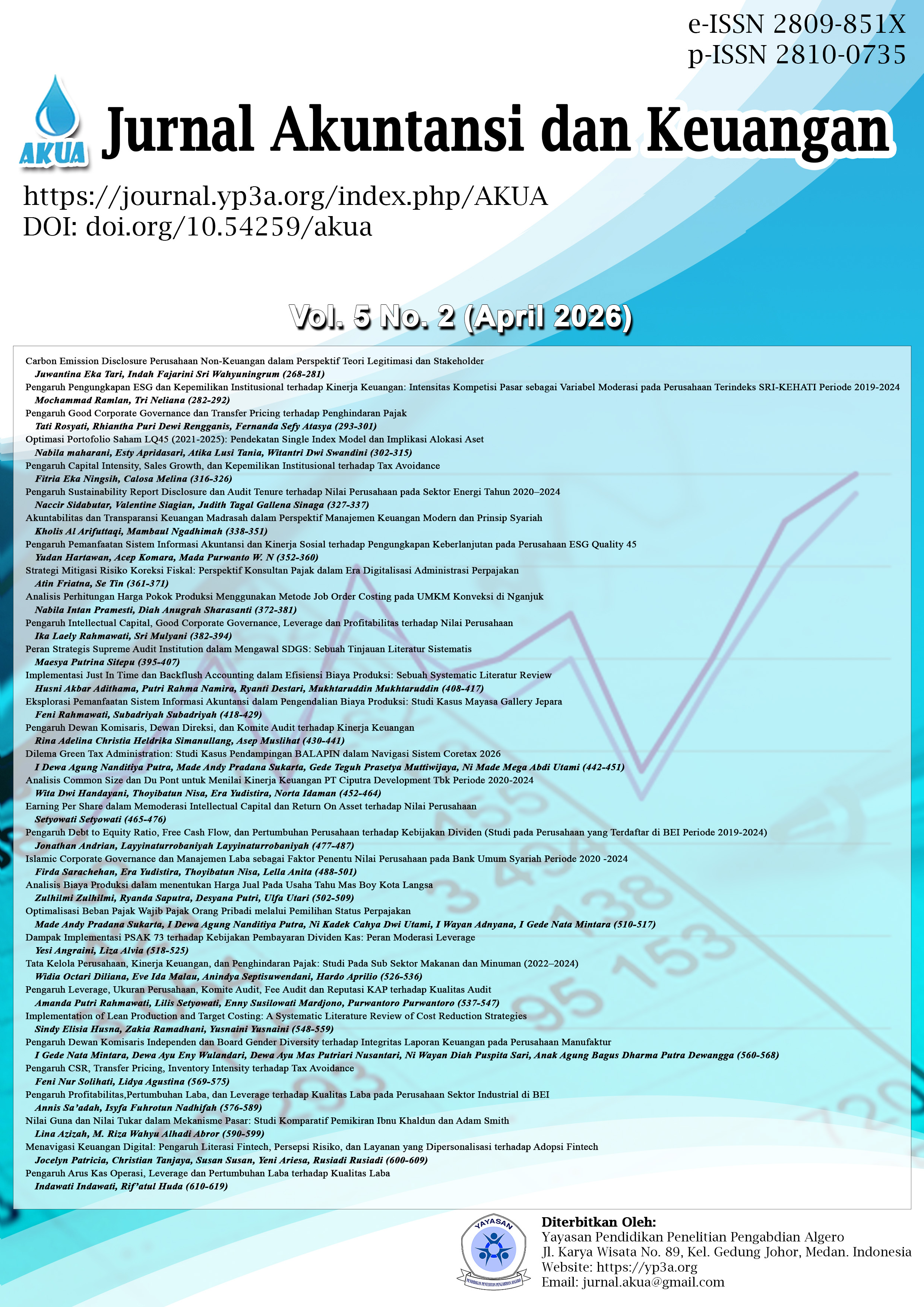
Implementasi Just In Time dan Backflush Accounting dalam Efisiensi Biaya Produksi: Sebuah Systematic Literatur Review
DOI:
https://doi.org/10.54259/akua.v5i2.7398Keywords:
Just In Time, Backflush Accounting, Production Cost Efficiency, Lean Manufacturing, Systematic Literature ReviewAbstract
The overarching ambition of this inquiry is to scrutinize how JIT and backflush accounting in the context of production cost efficiency through SLR method. A search for articles was carried out on the Scopus-indexed database using structured keyword combinations, covering publications from 2021 to 2025. From 87 initially identified articles, ten article aligned with the predefined parameters and were systematically synthesized. The findings reveal that JIT implementation consistently contributes to operational efficiency improvements through waste elimination, work-in-process reduction, and demand-driven material flow optimization, while simultaneously generating measurable positive impacts on key financial indicators such as ROI, ROS, and profit margins. Meanwhile, backflush accounting is confirmed as an inherently compatible cost recording system within JIT environments, capable of reducing accounting administrative overhead without compromising reporting accuracy. The integration of both systems generates a stronger cost control synergy compared to isolated implementation. However, a significant research gap remains, as studies simultaneously examining JIT and backflush accounting as an integrated analytical framework are still scarce. This study contributes to management accounting literature by providing a systematic synthesis that can guide both future empirical research and practical decision-making in manufacturing firms.
Downloads
References
E. Nugraha and L. Nugroho, “Application of Value-Based Management in Management Accounting : Increasing Efficiency Through Technology Integration in the Industrial,” vol. 1, no. 3, pp. 150–162, 2024.
M. Dieste, R. Panizzolo, and J. A. Garza-reyes, “A systematic literature review regarding the influence of lean manufacturing on firms ’ financial performance,” vol. 32, no. 9, pp. 101–121, 2026, doi: 10.1108/JMTM-08-2020-0304.
G. M. Ningrum, “Analisis metode akuntansi biaya dalam pengendalian produksi,” no. 0717, pp. 35–49, 2020.
A. S. Hutajulu et al., “CONTROL OF MANUFACTURING OVERHEAD COSTS IN PRODUCT COSTING: A SYSTEMATIC LITERATURE REVIEW,” pp. 163–176, 2015.
W. N. Hidayat, K. Praditya, S. Ulima, and P. Waz, “Dampak Just in Time ( JIT ) terhadap Kinerja Operasional : Literature Review,” vol. 3, 2025.
E. Juliansyah, “Literatur Review : Implementasi Sistem Just In Time Dalam Industri Manufaktur: Tren, Tantangan, Dan Peluang,” vol. 2, no. 4, pp. 2510–2519, 2025.
G. Yang and Y. Hu, “Manufacturing background CEOs and corporate cost management : evidence from listed manufacturing firms Manufacturing background CEOs and corporate cost,” China J. Account. Stud., vol. 10, no. 2, pp. 274–300, 2022, doi: 10.1080/21697213.2022.2105676.
T. Susanti, D. Aristiawan, and H. Taufid, “Implementation of Just-In-Time ( JIT ) in Inventory Management : A Case Study in a Manufacturing Company,” vol. 5, no. 7, pp. 6208–6216, 2025.
M. J. Page et al., “The PRISMA 2020 statement: an updated guideline for reporting systematic reviews,” 2021, doi: 10.1136/bmj.n71.
H. Snyder, “Literature review as a research methodology: An overview and guidelines,” J. Bus. Res., vol. 104, pp. 333–339, 2019.
J. Singh, “Strategic implementation of just-in-time practices for enhancing the performance of manufacturing industry – an empirical investigation Jagdeep Singh * Harwinder Singh,” vol. 35, no. 4, pp. 369–388, 2021.
M. O. Ogunseye et al., “A Multi-Echelon Genetic Algorithm and Just-in-Time Approach for Supply Chain Optimization,” vol. 46, no. 11, pp. 213–231, 2025.
S. Abbasi, S. Jabari, A. Mirzaei, A. Azimi, and S. Zamanian, “Using a Just-In-Time Approach in the Green Supply Chain , Taking Into Account CO 2 Emissions , Under Uncertainty in the Pre- and Post-COVID-19 Situation,” vol. 2025, 2025, doi: 10.1155/ddns/2153480.
A. C. Lara, E. Maria, P. Menegon, S. Sehnem, and E. Kuzma, “Relationship between Just in Time , Lean Manufacturing , and Performance Practices : a,” pp. 1–21, 2022.
J. Garc, “Enhancing Corporate Sustainability through Just-In-Time ( JIT ) Practices : A Meta-Analytic Examination of Financial Performance Outcomes,” 2024.
J. Park, M. Kim, M. El Mistiri, R. Kha, and S. Banerjee, “Advancing Understanding of Just-in-Time States for Supporting Physical Activity ( Project JustWalk JITAI ): Protocol for a System ID Study of Just-in-Time Adaptive Interventions Corresponding Author :,” vol. 12, pp. 1–20, 2023, doi: 10.2196/52161.
S. Juhara, “Optimizing Supply Chain Management : Strategies for Enhancing Efficiency and Reducing Costs in Manufacturing Industries,” vol. 1, no. 1, pp. 37–44, 2024.
Kilic, “A Simulation Approach For Transition To Jit Production System,” vol. 20, pp. 489–500, 2021.
E. P. Enyi, O. G. Oyeyemi, and A. P. Olabode, “Budgetary Control and Profitability of Listed Foods and Beverages Producing Companies in Nigeria,” vol. 9, no. 01, pp. 45–58, 2025.
F. A. Mahmoud, “Integration Between JIT and ABC 11 Systems and Their Role in Cost Reduction,” vol. 8, no. 1, pp. 1–15, 2024.
Downloads
Published
How to Cite
Issue
Section
License
Copyright (c) 2026 Husni Akbar Adithama, Putri Rahma Namira, Ryanti Destari, Mukhtaruddin

This work is licensed under a Creative Commons Attribution 4.0 International License.
Hak cipta pada setiap artikel adalah milik penulis.
Penulis mengakui bahwa AKUA (Jurnal Akuntansi dan Keuangan) sebagai publisher yang mempublikasikan pertama kali dengan lisensi Creative Commons Attribution 4.0 International License.
Penulis dapat memasukan tulisan secara terpisah, mengatur distribusi non-ekskulif dari naskah yang telah terbit di jurnal ini kedalam versi yang lain, seperti: dikirim ke respository institusi penulis, publikasi kedalam buku, dan lain-lain. Dengan mengakui bahwa naskah telah terbit pertama kali pada AKUA (Jurnal Akuntansi dan Keuangan).