
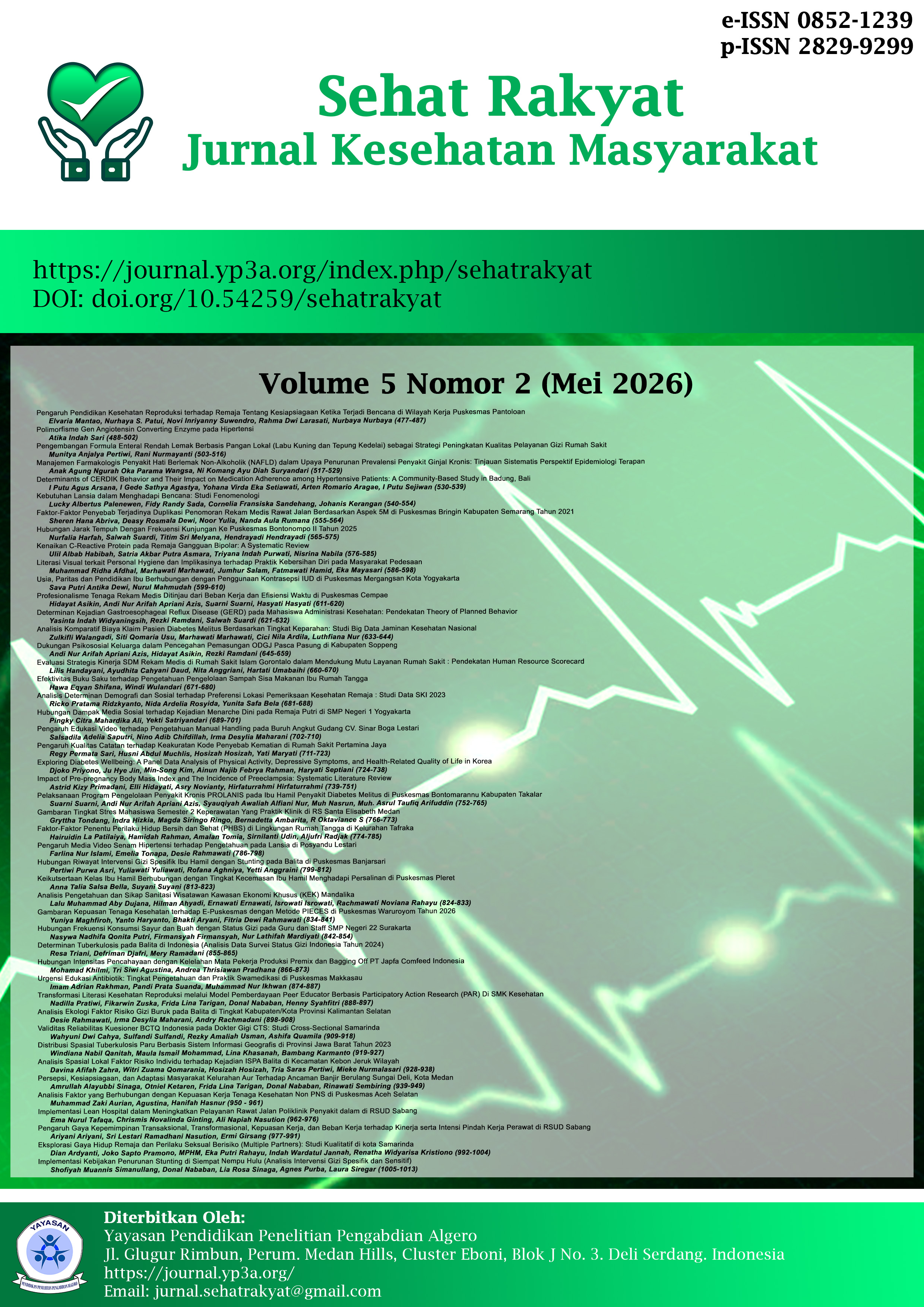
Pengembangan Formula Enteral Rendah Lemak Berbasis Pangan Lokal (Labu Kuning dan Tepung Kedelai) sebagai Strategi Peningkatan Kualitas Pelayanan Gizi Rumah Sakit
DOI:
https://doi.org/10.54259/sehatrakyat.v5i2.7103Keywords:
Low Fat Enteral Nutrition, Pumpkin, Soy Flour, Sensory Evaluation, Flow Rate, ViscosityAbstract
Low-fat enteral nutrition is an essential component of hospital nutritional support for patients with fat intolerance, hepatobiliary and pancreatic disorders, and post operative conditions. Nevertheless, standard hospital formulas frequently present limitations in nutritional adequacy, physical properties particularly texture and sensory acceptability. This study aimed to evaluate the effects of varying concentrations of pumpkin flour and soybean flour on the nutritional composition, viscosity, flow rate, and sensory acceptability of a low-fat enteral nutrition formula. A quasi experimental study employing a post-test-only control group design was conducted by comparing a standard hospital formula (F0) with two modified formulations (F1 and F2). The study was performed from October to December 2025 at RSUD Gambiran Kediri and the Integrated Laboratory of Poltekkes Kemenkes Malang. Hedonic testing involved 20 nutrition students using a 4-point hedonic scale. Nutritional composition was calculated based on the Indonesian Food Composition Table. Sensory data were analyzed using the Kruskal Wallis and Mann Whitney U tests, while flow rate was assessed using one-way ANOVA. The findings indicated that the modified formulations significantly increased energy and protein content compared with the standard formula while maintaining low fat levels. Formula F2 exhibited the most favorable physical characteristics, with a flow rate of 5.14 cc/s and a viscosity of 427.5 cP, and achieved the highest acceptance scores for taste and color (p < 0.05). All formulations complied with hospital food service budget standards. Therefore, F2 demonstrates strong potential as a nutritionally adequate and acceptable alternative low-fat enteral formula.
Downloads
References
Abu-El-Haija, M., Uc, A., et al. (2018). Nutritional considerations in pediatric pancreatitis. Journal of Pediatric Gastroenterology and Nutrition, 67(1), 133–143. https://doi.org/10.1097/MPG.0000000000002023
Afriyana, S. (2022). Analisis zat gizi makro, BCAA, viskositas formula enteral bagi pasien sirosis hepatis. Svastā Harena Rafflesia, 1(1), 159. https://doi.org/10.33088/shr.v1i1.159
Anggraeni, G. D., Nissa, C., Candra, A., & Kurniawati, D. M. (2023). Analisis kandungan gizi dan viskositas formula enteral berbasis tepung sorgum dan tepung kedelai untuk diabetes mellitus. Journal of Nutrition College, 12(4), 380–394. https://doi.org/10.14710/jnc.v12i4.38094
Bandawati, B., Mexitalia, M., et al. (2016). Pengaruh asupan energi dan protein terhadap perubahan status gizi pasien anak selama dirawat di RSUP Dr. Kariadi Semarang. Jurnal Gizi Indonesia, 4(2), 102–106. https://doi.org/10.14710/jgi.4.2.102-106
Chloupek, A., & Jurkiewicz, D. (2024). The effect of hospital-based liquid diet and commercial formulas on laboratory parameters and postoperative complications in patients with head and neck cancer. Journal of Clinical Medicine, 13(7), 1844. https://doi.org/10.3390/jcm13071844
Citrawati, A., & Pratama, R. (2024). [Judul artikel]. [Nama Jurnal].
Diniyyah, S. R., & Nindya, T. S. (2017). Asupan energi, protein, dan lemak dengan kejadian gizi kurang pada balita. Amerta Nutrition, 1(4), 302–308. https://doi.org/10.20473/amnt.v1i4.7139
Dwi Setiyani, A., et al. (2024). Pemberian diet tinggi protein dan energi pada pasien Covid-19 dengan pneumonia: Sebuah laporan kasus. Media Gizi Kesmas, 13(1), 419–426. https://doi.org/10.20473/mgk.v13i1.2024.419-426
Fredericks, L., et al. (2024). Will a programmatic framework integrating food is medicine achieve value on investment? Journal of General Internal Medicine. https://doi.org/10.1007/s11606-024-09192-w
Gomes, F., Schuetz, P., et al. (2018). ESPEN guidelines on nutritional support for polymorbid internal medicine patients. Clinical Nutrition, 37(1), 337–353. https://doi.org/10.1016/j.clnu.2017.06.023
Harti, L. B., et al. (2024). Pengaruh nutritional support terhadap luaran klinis pada pasien intensive care unit. Amerta Nutrition, 8(2), 328–334. https://doi.org/10.20473/amnt.v8i2.2024.328-334
Hartati, Y., Erian, C., Telisa, I., Meilina, A., Podojoyo, P., & Faridi, A. (2023). The potential of catfish (Clarias gariepinus) and yellow pumpkin (Cucurbita moschata) as enteral formulas for diabetes mellitus. ARGIPA (Arsip Gizi dan Pangan), 8(2), 119–129. https://doi.org/10.22236/argipa.v8i2.11902
Hidayah, E. M., Hernanda, R., & Sutrisno, S. (2024). Asuhan keperawatan keluarga dengan implementasi diet labu kuning untuk penderita diabetes melitus di wilayah kerja Puskesmas Sukoharjo. Jurnal Ventilator, 2(4), 153–158. https://doi.org/10.59680/ventilator.v2i4.1538
Hizni, A., et al. (2024). Karakteristik sensoris dan kandungan gizi beras analog berbahan mocaf dan sagu yang disuplementasi protein tempe dan ikan kembung. Media Informasi, 20(2), 349–361. https://doi.org/10.37160/mijournal.v20i2.349
Hron, B., & Rosen, R. (2020). Viscosity of commercial food-based formulas and home-prepared blenderized feeds. Journal of Pediatric Gastroenterology and Nutrition. https://doi.org/10.1097/MPG.0000000000002657
Hu, Z., Zhou, X., et al. (2016). Diet guidance for patients undergoing follow-up after liver transplantation. Chinese Journal of Organ Transplantation, 37(4), 232–235. https://doi.org/10.3969/j.issn.2095-5332.2016.04.009
Ibrahim, H., Mansour, M., et al. (2020). Peptide-based formula versus standard-based polymeric formula for critically ill children. Archives of Medical Science, 16(2), 346–353. https://doi.org/10.5114/aoms.2020.94157
Jackson, A., Lalji, A., et al. (2017). The efficacy of a low-fat diet to manage bile acid malabsorption. Clinical Medicine, 17(5), 412–415. https://doi.org/10.7861/clinmedicine.17-5-412
Kartika, A., Kurniawan, A., et al. (2023). Analysis of the temperature effect on the liquids viscosity. Jurnal Penelitian dan Pembelajaran Fisika Indonesia, 5(1). https://doi.org/10.29303/jppfi.v5i1.214
Kementerian Kesehatan Republik Indonesia. (2013). Laporan nasional Riset Kesehatan Dasar (Riskesdas) 2013. Badan Penelitian dan Pengembangan Kesehatan.
Kementerian Kesehatan Republik Indonesia. (2018). Laporan nasional Riset Kesehatan Dasar (Riskesdas) 2018. Badan Penelitian dan Pengembangan Kesehatan.
Kementerian Kesehatan Republik Indonesia. (2024). Laporan nasional Riset Kesehatan Dasar (Riskesdas) 2024. Badan Penelitian dan Pengembangan Kesehatan.
Marzeline, C. N. M., & Adi, A. C. (2017). Substitusi bekatul dan bengkuang terhadap mutu mini pao. Amerta Nutrition, 1(4), 282–290. https://doi.org/10.20473/amnt.v1i4.7134
Moro, K., Koyama, Y., et al. (2016). Low fat-containing elemental formula after esophagectomy. Clinical Nutrition, 35(6), 1419–1425. https://doi.org/10.1016/j.clnu.2016.03.018
Nurjanah, H., Setiawan, B., & Roosita, K. (2020). Potensi labu kuning (Cucurbita moschata) sebagai makanan tinggi serat dalam bentuk cair. Indonesian Journal of Human Nutrition, 7(1), 58–65. https://doi.org/10.21776/ub.ijhn.2020.007.01.6
Putriningtyas, N. D., Tyastuti, L. E., & Purwaningsih, S. (2023). Modifikasi makanan enteral tinggi asam amino esensial. Nutri-Sains: Jurnal Gizi, Pangan dan Aplikasinya, 7(1), 49–58. https://doi.org/10.21580/ns.2023.7.1.11759
Rauf, R., & Utami, A. (2020). Nutrition value and viscosity of polymeric enteral nutrition products based on purple sweet potato flour with variation of maltodextrin levels. Jurnal Gizi Indonesia, 8(2), 119–125. https://doi.org/10.14710/jgi.8.2.119-125
Santosa, F. L. (2024). Pelaksanaan proses asuhan gizi terstandar pemberian diet diabetes melitus, rendah purin, dan rendah lemak terhadap pasien diabetes melitus tipe 2 dan suspect cerebrovascular accident: Sebuah laporan kasus. Media Gizi Kesmas, 13(1), 21–29. https://doi.org/10.20473/mgk.v13i1.2024.21-29
Saputra, S. H. (2016). Mikroenkapsulasi β-karoten dari minyak sawit mentah untuk suplemen pro vitamin A. Jurnal Riset Teknologi Industri. https://doi.org/10.26578/jrti.v8i15.1548
Sreehari, P., Sheshadri, K. N., & Vijayakumar, S. (2025). An evaluation of APA citation and referencing accuracy in library and information science doctoral theses. International Journal of Research in Library Science, 11(2). https://doi.org/10.26761/ijrls.11.2.2025.1868
Susetyowati, S., Lestari, L. A., Astuti, H., Setyopranoto, I., & Probosuseno, P. (2020). Analisis mikrobia dan organoleptik makanan cair instan berbasis pangan lokal untuk perbaikan status gizi pasien. Amerta Nutrition, 4(3), 225–230. https://doi.org/10.20473/amnt.v4i3.2020.225-230
Tanuwijaya, L. K., et al. (2016). Potensi “Khimelor” sebagai tepung komposit tinggi energi tinggi protein berbasis pangan lokal. Indonesian Journal of Human Nutrition, 3(Suplemen), 59–69. https://doi.org/10.21776/ub.ijhn.2016.003.suplemen.8
Wati, R., Novita, R., & Miko, A. (2016). Karakteristik organoleptik formulasi biskuit berbasis tepung labu kuning. Indonesian Journal of Human Nutrition, 3(Suplemen), 70–80. https://doi.org/10.21776/ub.ijhn.2016.003.suplemen.10
Weston, S. C., Crespo, A., et al. (2022). Stir, shake or blend: A comparison of methods used to reduce viscosity of blenderized tube feedings. Journal of Pediatric Gastroenterology and Nutrition. https://doi.org/10.1097/MPG.0000000000003479
Wewalka, M., Drolz, A., et al. (2018). Enteral nutrition formulas and thermogenesis in critically ill patients. European Journal of Clinical Nutrition, 72(4), 580–587. https://doi.org/10.1038/s41430-018-0111-4
Williams, L., Rhodes, K. S., et al. (2018). Familial chylomicronemia syndrome and dietary recommendations. Journal of Clinical Lipidology, 12(4), 864–876. https://doi.org/10.1016/j.jacl.2018.04.010
Wijayanti, D., Saraswati, I. W., & Khairunnisa, A. N. (2024). Development of hospital enteral formula for diabetes using tempeh flour with dragon fruit and tomato addition. International Journal of Health and Information System, 2(2), 92–100. https://doi.org/10.47134/ijhis.v2i2.48
Wittholz, K., Hinckfus, C., et al. (2024). Association between protocol change to a higher-protein formula with lower energy targets and nutrient delivery in critically ill patients with COVID-19. Journal of Parenteral and Enteral Nutrition, 48(4), 519–530. https://doi.org/10.1002/jpen.2620
Younossi, Z., Anstee, Q. M., et al. (2017). Global burden of NAFLD and NASH: Trends, predictions, risk factors and prevention. Nature Reviews Gastroenterology & Hepatology, 14(6), 345–358. https://doi.org/10.1038/nrgastro.2017.109
Zaki, I., Ramadhan, G. R., & Putri, W. A. K. (2022). Kandungan gizi formula enteral berbasis ubi ungu, ikan lele, tempe kedelai, labu kuning. Jurnal Gizi dan Pangan Soedirman, 6(2). https://doi.org/10.20884/1.jgipas.2022.6.2.6949
Downloads
Published
How to Cite
Issue
Section
License
Copyright (c) 2026 Munitya Anjalya Pertiwi, Rani Nurmayanti

This work is licensed under a Creative Commons Attribution 4.0 International License.
Hak cipta pada setiap artikel adalah milik penulis.
Penulis mengakui bahwa SEHATRAKYAT (Jurnal Kesehatan Masyarakat) sebagai publisher yang mempublikasikan pertama kali dengan lisensi Creative Commons Attribution 4.0 International License.
Penulis dapat memasukan tulisan secara terpisah, mengatur distribusi non-ekskulif dari naskah yang telah terbit di jurnal ini kedalam versi yang lain, seperti: dikirim ke respository institusi penulis, publikasi kedalam buku, dan lain-lain. Dengan mengakui bahwa naskah telah terbit pertama kali pada SEHATRAKYAT (Jurnal Kesehatan Masyarakat).






