
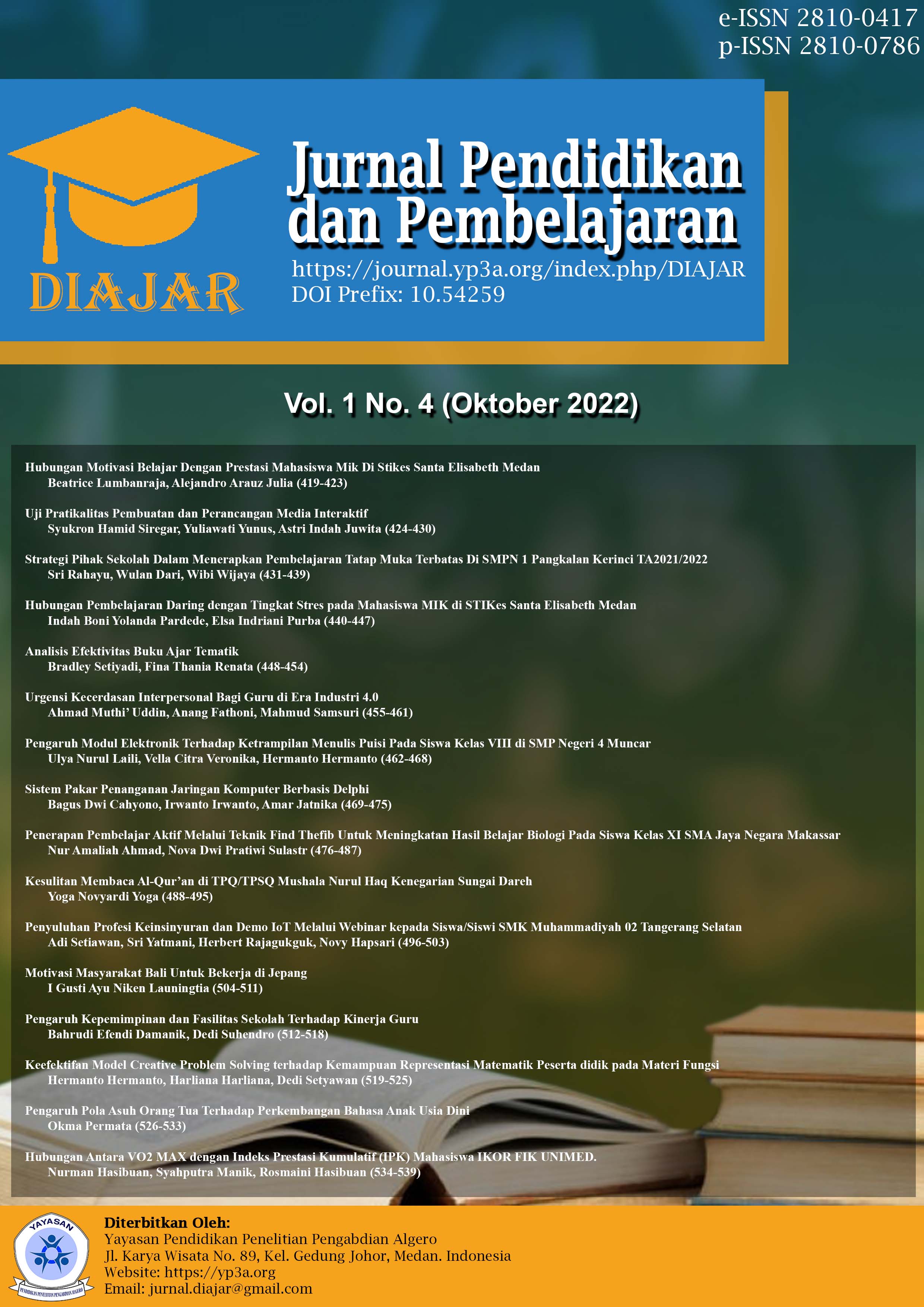
Analisis Efektivitas Buku Ajar Tematik
DOI:
https://doi.org/10.54259/diajar.v1i4.1141Keywords:
effectiveness, thematic textbooksAbstract
This study aims to describe the effectiveness of the thematic textbooks for the Kurikulum 2013 at the SD YKPP in Jambi City by knowing the obstacles in implementing the 2013 thematic textbooks at the SD YKPP. In this study the method used was a qualitative method with a case study approach. In collecting data, this research conducted in-depth interviews with the participants. Participants who were interviewed consisted of one principal and six teachers. The results showed that (1) The application of thematic textbooks at SD YKPP had been going well by adjusting the conditions of students and schools. (2) The obstacle faced in implementing the thematic textbooks for the Kurikulum 2013 at the SD YKPP is the adjustment of the differences in the learning abilities of each student. (3) Thematic textbooks are considered to have been effectively implemented in the SD YKPP, supported by some evidence that the facilities and infrastructure at the SDYKPP are adequate, there is an increase in overall student achievement every semester, and the achievement of the objectives of the Kurikulum 2013
Downloads
References
A.B. Permana & P. Pujiastuti. Pengembangan Buku Ajar Tematik Integratif Berbasis Discovery Learning dalam Peningkatan Motivasi Belajar dan Karakter Tanggung Jawab. Jurnal Pendidikan Karakter, Volume 8 Nomor 1, p.46-55, 2017. DOI: https://doi.org/10.21831/jpk.v7i1.15499
B. Segoro., A. Sapto & Yuniastuti. Buku Ajar Tematik Berbasis Muatan Lokal untuk Kelas IV Sekolah Dasar. Jurnal Pendidikan: Teori, Penelitian dan Pengembangan, Volume 4 Nomor 1, p.1-5, 2019. DOI: http://dx.doi.org/10.17977/jptpp.v4i1.11827
S. Perwitasari., Wahjoedi & S. Akbar. Pengembangan Bahan Ajar Tematik Berbasis Kontekstual. Jurnal Pendidikan: Teori, Penelitian dan Pengembangan, Volume 3 Nomor 3, p.278-285, 2018.
H. Nupus., A. Triyogo & A. Valen. Pengembangan Buku Ajar Pendamping Tematik Terpadu Berbasis Kontekstual pada Siswa Sekolah Dasar. Jurnal Basicedu, Volume 5 Nomor 5, p.3279-3289, 2021. DOI: https://doi.org/10.31004/basicedu.v5i5.1311
M. Syaifuddin. Implementasi Pembelajaran Termatik di Kelas 2 SD Negeri Demangan Yogyakarta. Tadris, Volume 02 Nomor 2, p.139-144, 2017. DOI: https://doi.org/10.24042/tadris.v2i2.2142
Akrim., Nurjanah & N. Ginting. Pengembangan Program Pembelajaran Tematik Terpadu Bagi Guru-guru SD Muhammadiyah di Kota Medan. Jurnal Prodikmas, Volume 2 Nomor 2, p.103-111, 2018. DOI: http://dx.doi.org/10.30596%2Fjp.v2i2.2462
H.T. Wahyuni., P. Setyosari & D. Kuswandi. Implementasi Pembelajaran Tematik Kelas 1 SD. Edcomtech, Volume 1 Nomor 2, p.129-136, 2016.
F.K. Amris & Desyandri. Pembelajaran Tematik Terpadu Menggunakan Model Problem Based Learning di Sekolah Dasar. Jurnal Basicedu, Volume 5 Nomor 4, p.2171-2180, 2021. DOI: http://journal2.um.ac.id/index.php/edcomtech/article/view/1799
L.J. Moleong. Metode Penelitian Kualitatif, Cetakan ke-38. Bandung: Remaja Rosdakarya, 2018.
S. Arikunto. Prosedur Penelitian: Suatu Pendekatan Praktek, Cetakan ke-13. Jakarta: Rineka Cipta, 2016.
H. Nawawi & M. Martini. Penelitian Terapan. Yogyakarta: Gadjah Mada University Press, 2005.
P. Setyosari. Menciptakan Pembelajaran yang Efektif dan Berkualitas. Jinotep, Volume 1 Nomor 1, p.20-30, 2017. DOI: http://journal2.um.ac.id/index.php/jinotep/article/view/2103/1239
Fakhrurrazi. Hakikat Pembelajaran yang Efektif. Jurnal At-Tafkir, Volume XI Nomor 1, p.85-99, 2018. DOI: https://doi.org/10.32505/at.v11i1.529
E. Diana & M. Rofiki. Analisis Metode Pembelajaran Efektif di Era New Normal. Jurnal Review Pendidikan dan Pengajaran, Volume 3 Nomor 2, p.336-342, 2020. DOI: https://doi.org/10.31004/jrpp.v3i2.1356
R. Dunne & T. Wragg. Pembelajaran yang Efektif, Terjemahan: A. Yassin, Cetakan ke-5. Jakarta: Grasindo, 1996.
W.J. Popham & E.L. Baker. Teknik Mengajar Secara Sistematis, Terjemahan: A. Hadi. Jakarta: Rineka Cipta, 2008.
B. Setiyadi. Pengelolaan Sarana Prasarana Pendidikan: Konsep, Aturan dan Penggunaan. Purwokerto: Pena Persada, 2022.
I. Junaedi. Proses Pembelajaran yang Efektif. Jisamar, Volume 3 Nomor 2, p.19-25, 2019. DOI: https://journal.stmikjayakarta.ac.id/index.php/jisamar/article/view/86
H.S. Famaney & N.S. Wardani. Evaluasi Pembelajaran Tematik Terpadu Daring Siswa Kelas V SD. Jurnal Studi Guru dan Pembelajaran, Volume 4 Nomor 2, p.455-465, 2021. DOI: https://doi.org/10.30605/jsgp.4.2.2021.1316
A. Mudlofir. Pendidik Profesional: Konsep, Strategi dan Aplikasinya dalam Peningkatan Mutu Pendidik di Indonesia. Jakarta: Rajawali Press, 2012.
A. Majid. Pembelajaran Tematik Terpadu. Bandung: Remaja Rosdakarya, 2014.
A. Kunaini. Penilaian Pembelajaran Tematik di Madrasah. Jurnal Pedagogik, Volume 04 Nomor 02, p.146-165, 2017. DOI: https://doi.org/10.33650/pjp.v4i2.15
R. Jannah. Pengembangan Buku Ajar Tematik Bernuansa Islami untuk Madrasah Ibtidaiyah/Sekolah Dasar Islam. Muallimuna, Volume 2 Nomor 1, p.1-16, 2016. DOI: https://ojs.uniska-bjm.ac.id/index.php/muallimuna
F. Devirita, Neviyarni & Daharnis. Pengembangan Buku Ajar Berbasis Problem Based Learning di Sekolah Dasar. Jurnal Basicedu, Volume 5 Nomor 2, p.469-477, 2021. DOI: https://doi.org/10.31004/basicedu.v5i2.680
Y. Sari & S. Yustiana. Efektivitas Bahan Ajar Cerita Bergambar Bermuatan Religius terhadap Prestasi Belajar Siswa Kelas 1 Sekolah Dasar. Jurnal Ilmiah Pendidikan Dasar, Volume VIII Nomor 2, p.175-185, 2021. DOI: http://dx.doi.org/10.30659/pendas.8.2.175-185
Ananda, J., Solihat, D., & Suryana, Y. (2020). Nonverbal communication performed by foreign English teacher. Indonesian EFL Journal, 6(2): 175-188. DOI: 10.25134/ieflj.v6i2.3424.
Anuradha & Singh, S. N. (2020). Impact of nonverbal signals in business communication. UGC Care Journal, 43(4): 60-65.
Downloads
Published
How to Cite
Issue
Section
License
Copyright (c) 2022 Bradley Setiyadi, Fina Thania Renata

This work is licensed under a Creative Commons Attribution 4.0 International License.
Hak cipta pada setiap artikel adalah milik penulis.
Penulis mengakui bahwa DIAJAR (Jurnal Pendidikan dan Pembelajaran) sebagai publisher yang mempublikasikan pertama kali dengan lisensi Creative Commons Attribution 4.0 International License.
Penulis dapat memasukan tulisan secara terpisah, mengatur distribusi non-ekskulif dari naskah yang telah terbit di jurnal ini kedalam versi yang lain, seperti: dikirim ke respository institusi penulis, publikasi kedalam buku, dan lain-lain. Dengan mengakui bahwa naskah telah terbit pertama kali pada DIAJAR (Jurnal Pendidikan dan Pembelajaran).









