
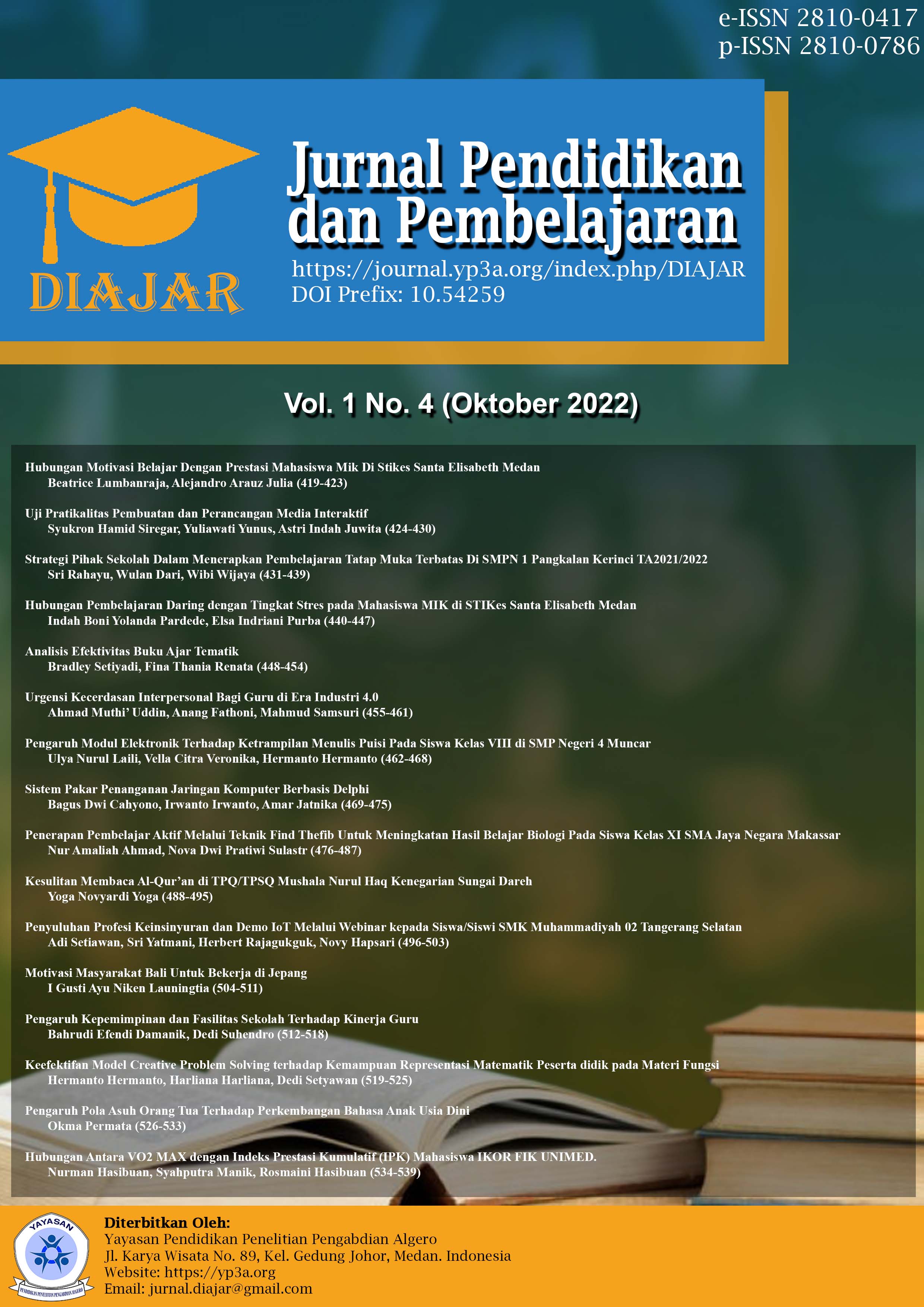
Penerapan Pembelajar Aktif Melalui Teknik Find Thefib Untuk Meningkatan Hasil Belajar Biologi Pada Siswa Kelas XI SMA Jaya Negara Makassar
DOI:
https://doi.org/10.54259/diajar.v1i4.1225Keywords:
Learning Technique, Find The Fib, Learning OutcomesAbstract
Research This is class action research( PTK ). The subjects of this study are class XI students of SMA Jaya Negara Makassar.This study aims to describe the improvement of biology learning outcomes through the Find TheFib technique in biology learning for class XI students of SMA Jaya Negara Makassar, with a total of 24 students consisting of 11 men and 13 women. The Find theFib technique is a technique that uses a true and false system, where 2 choices are right and 1 choice is wrong. The research method used is class action research (PTK) with quantitative and qualitative approaches. Data collection using interview instruments, observation sheets and test results. The data analysis techniques in this study use quantitative analysis and qualitative analysis. Based on the results of this research, learning through the Find the Fib technique can increase activities and learning outcomes of Biology in class XI students of SMA Jaya Negara Makassar
Downloads
References
A.Y.Soegeng, (2016). Landasan Kependidikan. Yogyakarta: Magnum Pustaka Utama
Akhmad, N. A. (2019). analisis kesulitan belajar peserta didik terhadap proses pembelajaran IPA pada kelas viii SMP Negeri 1 Barru. Karst: Jurnal Pendidikan Fisika Dan Terapannya, 2(2), 60-63.
Akhmad, N. A. (2020). Analisis Respon Mahasiswa Terhadap Perkuliahan Daring Di Prodi Biologi STKIP Pi Makassar. Karst: Jurnal Pendidikan Fisika Dan Terapannya, 3(2), 62-65.
Akhmad, N. A., Samsi, A. N., Ahmad, F., & Nur, S. (2022). PELATIHAN PRAKTIKUM IPA BERBAHAN LINGKUNGAN SEKITAR PADA GURU IPA SMP KABUPATEN MAROS. J-ABDI: Jurnal Pengabdian kepada Masyarakat, 1(11), 3115-3122.
Anderson.(1981).Efficient Reading: A Practical Guide. Sidney: McGraw-Hill Book Company
Arikunto. (2000). Penelitian Tindakan Kelas. Jakarta: Bumi Aksara
Basri, S., & Akhmad, N. A. (2018). Penggunaan metode bermain snakes and ladders pada pembelajaran ipa fisika untuk meningkatkan minat belajar peserta didik. Jurnal Pendidikan Fisika, 6(3), 309-323.
Blomm, Benjamin S. (1956). Taxonomy of Educational Objectives: The Classification of Educational Goals, Handbook I Cognitive Domain. New York: Longmans, Green and Co
Bonwell, C. C, and James (2012). Actib=ve Learning Creating Exciting in the classroom. Washinton DC: The Gorge Washinton University
Fannie, R. D., & Rohati, R. (2014). Pengembangan lembar kerja siswa (LKS) berbasis POE (predict, observe, explain) pada materi program linear kelas XII SMA. Sainmatika: Jurnal Sains dan Matematika Universitas Jambi, 8(1), 221053.
Hamsyah, E. F., Ahmad, F., & Akhmad, N. A. (2021). Hubungan Kesadaran Metakognitif terhadap Keterampilan Proses menggunakan Model Pembelajaran Inkuiri Terbimbing Berbantuan Lembar Kerja Mahasiswa. Jurnal Kreatif Online, 9(4), 1-9.
Rasyid, Harun. Teknik Penarikan Sample dan Penyusunan Skala. Bandung: Program Pasca Sarjana Universitas Padjajaran
Rober.(2009).Ada dua macam defenisi belajar.Jakarta: Grafindo
Sulastri, N. D. P. (2020). Development Of Learning Media Based On Windows Producers To Improve Student Metacognitional Awareness. Jurnal Inovasi Pendidikan dan Sains, 1(3), 79-84.
Warsono dan Hariyanto.(2016). Find the Fib. Bandung: PT.Remaja Rosdakarya.
Aulia, Rina, & Fauzia. (2015). Analisis Fenomenologi Eksistensi Narapidana Pelaku Pembunuhan Berencana di Lembaga Pemasyarakatan. Ecopsy. Vol.2 Cet.1. Hal 13-21
Aw Suranto. (2010). Komunikasi Sosial Budaya. Yogyakarta: Graha Ilmu.
Downloads
Published
How to Cite
Issue
Section
License
Copyright (c) 2022 Nur Amaliah Ahmad, Nova Dwi Pratiwi Sulastri

This work is licensed under a Creative Commons Attribution 4.0 International License.
Hak cipta pada setiap artikel adalah milik penulis.
Penulis mengakui bahwa DIAJAR (Jurnal Pendidikan dan Pembelajaran) sebagai publisher yang mempublikasikan pertama kali dengan lisensi Creative Commons Attribution 4.0 International License.
Penulis dapat memasukan tulisan secara terpisah, mengatur distribusi non-ekskulif dari naskah yang telah terbit di jurnal ini kedalam versi yang lain, seperti: dikirim ke respository institusi penulis, publikasi kedalam buku, dan lain-lain. Dengan mengakui bahwa naskah telah terbit pertama kali pada DIAJAR (Jurnal Pendidikan dan Pembelajaran).









