
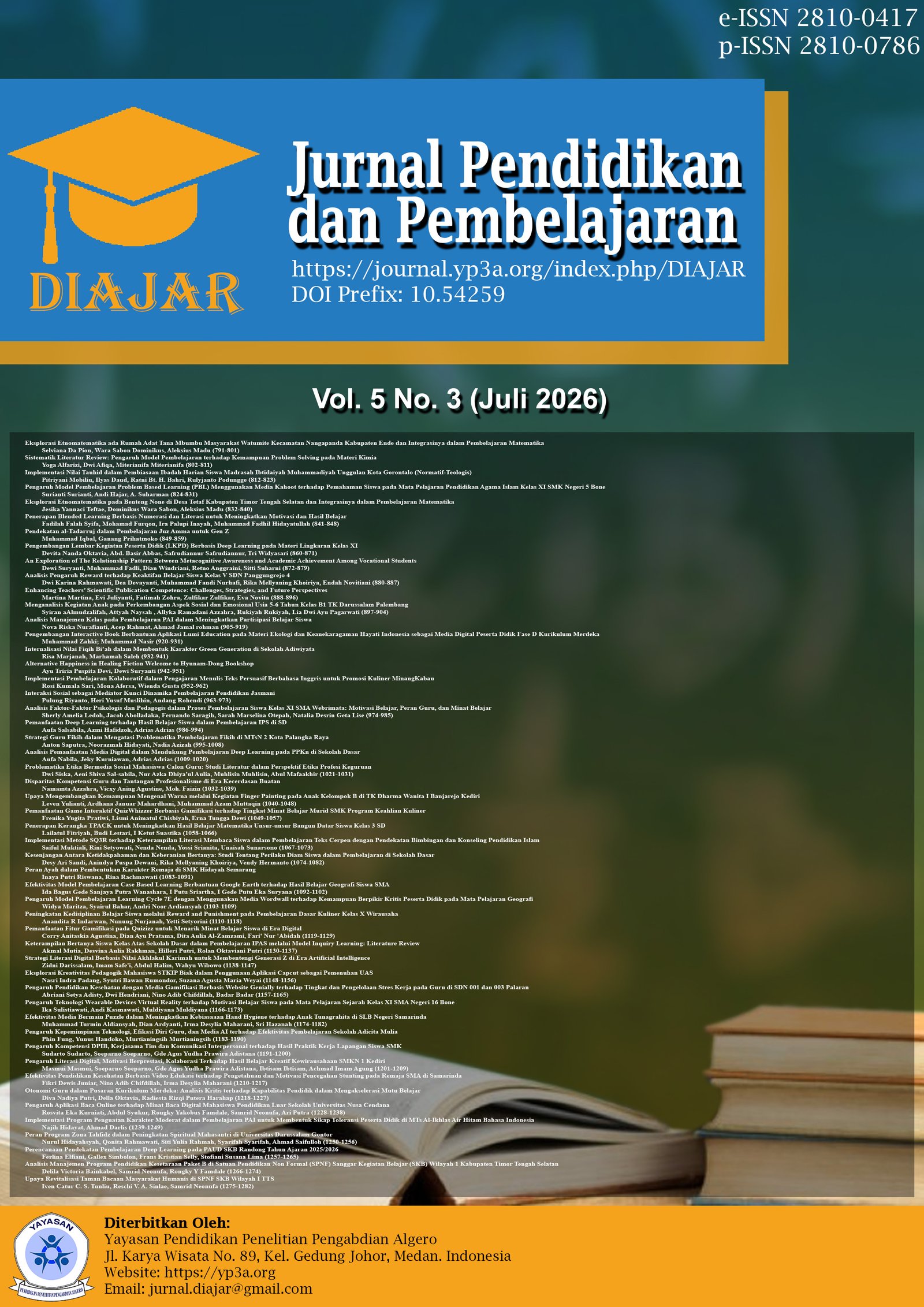
Pengaruh Literasi Digital, Motivasi Berprestasi, Kolaborasi Terhadap Hasil Belajar Kreatif Kewirausahaan SMKN 1 Kediri
DOI:
https://doi.org/10.54259/diajar.v5i3.7844Keywords:
Digital Literacy, Achievement Motivation, Collaboration, Student Learning Outcomes, N-Gain ScoreAbstract
The rapid development of technology in the digital era demands a transformation in education, where students are expected to not only be proficient in using digital devices but also possess structured reasoning skills to optimize their academic achievements. This study aims to analyse the partial and simultaneous effects of Digital Literacy (X1), Achievement Motivation (X2), and Collaboration (X3) on increasing students' learning outcomes (N-Gain Score / Y). The research method employed is a quantitative experiment involving a sample of 68 respondents. Data were collected using structured questionnaires for the independent variables and test instruments (Pre-test and Post-test) to measure the dependent variable. Data analysis was performed using Stata software through multiple linear regression and classical assumption testing.The partial results (t-test) indicate that: (1) Digital Literacy (X1) has a positive and significant effect on learning outcomes (t = 3.19; p = 0.002); (2) Achievement Motivation (X2) has a positive and significant effect on learning outcomes (t = 2.52; p = 0.014); and (3) Collaboration (X3) has a positive and significant effect on learning outcomes (t = 2.21; p = 0.031). Furthermore, the simultaneous test (F-test) proves that Digital Literacy, Achievement Motivation, and Collaboration collectively exert a highly robust and significant influence on the improvement of students' learning outcomes (F = 24.85; p = 0.0000). The R-Square value of 0.5382 indicates that the combined contribution of these three variables explains 53.82% of the variance in students' N-Gain Scores, while the remaining 46.18% is influenced by other factors outside this research model
Downloads
References
M. Arifin, “Digitalisasi Industri Konstruksi di Era 4.0,” Teknologi Konstruksi, vol. 12, pp. 45–58, 2021.
M. Prasetyo, “Transformasi Pendidikan Vokasi Menuju BIM-Ready,” Jurnal Pendidikan Teknik Sipil, vol. 9, pp. 112–125, 2022.
A. Setyawan, “Link and Match SMK dengan Dunia Industri Konstruksi,” Vokasi Indonesia, vol. 11, pp. 22–23, 2025.
Kemendikbudristek, “Spektrum Keahlian dan Konversi Spektrum Keahlian Sekolah Menengah Kejuruan/Madrasah Aliyah Kejuruan pada Kurikulum Merdeka,” 2024.
BPS, “Laporan Tenaga Kerja Sektor Konstruksi Indonesia 2024,” Jakarta, 2024.
R. Aisyi, “Literasi Digital dalam Pembelajaran Desain Pemodelan,” Jurnal Informasi Pendidikan, vol. 14, pp. 67–80, 2022.
E. Hargittai, “Second-Level Digital Divide: Differences in People’s Online Skills and Tech Usage,” First Monday, pp. 1–15, 2010.
R. R. Hake, “Analyzing Change/Gain Scores,” Am. Educ. Res. J., vol. 35, pp. 64–88, 2022.
H. Hamzah, Motivasi Berprestasi dan Kolaborasi Tim. Jakarta: Bumi Aksara, 2021.
G. Siemens, “Connectivism: A Learning Theory for the Digital Age,” Int. J. Instr. Technologi Distance Learning, vol. 2, pp. 3–10, 2021.
S. Soeparno, M. Kris, Y. Hidayatulloh, and H. Ashoumi, “Contribution of occupational health and safety knowledge and vocational high school students attitude towards OHS behavior awareness .,” The 1st International Conference on Green Engineering for Sustainable Future (ICoGESF 2025), vol. 0, 2025, doi: https://doi.org/10.1051/e3sconf/202564506008.
J. Sweller, “Cognitive Load Theory and Educational Technology,” Education Technologi Resource Development, vol. 68, pp. 1–16, 2023.
S. Mulyono, “Pola Pembelajaran Kewirausahaan Melalui Pola Pikir Logis,” Jurnal Pembelajaran Vokasi, vol. 4, 2023.
R. Aisyi, “Tantangan Pembelajaran Kewirausahaan Berbasis Proyek di Era Digital,” Jurnal Inovasi Kurikulum Vokasi, vol. 14, pp. 67–80, 2022.
A. Pratama, “Kreativitas Pembuatan Produk Kreatif Siswa SMK,” Jurnal Inovasi Pembelajaran, vol. 5, pp. 88–95, 2022.
Sugiyono, Metode Penelitian Kuantitatif, Kualitatif, dan R&D. Bandung: Alfabeta, 2022.
dan S. U. N. Rachmawati, A. Wahyudi, “Literasi Digital dan Kesiapan Berwirausaha Siswa Vokasi di Era Disrupsi,” Jurnal Pendidikan dan Kebudayaan, pp. 145–158, 2024.
R. M. dan I. Saputra, “The Role of Digital Literacy in Enhancing Vocational Students’ Entrepreneurial Competencies,” International Journal of Vocational Education Studies, pp. 22–35, 2025.
P. Gilster, Digital Literacy. New York: Wiley Computer Publishing, 1997.
S. H. dan T. Wijaya, “Pengaruh Motivasi Berprestasi terhadap Hasil Belajar Projek Kreatif dan Kewirausahaan di SMK,” Jurnal Inovasi Pembelajaran Vokasi, pp. 78–89, 2024.
L. C. and X. Wang, “Collaborative Learning and Cognitive Load Distribution in Project-Based Entrepreneurship Education,” Educational Technology & Society, pp. 112–126, 2024.
B. Susanto, “Analisis Manajemen Kolaborasi dalam Pembelajaran Produk Kreatif dan Kewirausahaan,” Jurnal Teori dan Praksis Pembelajaran, pp. 45–56, 2025.
P. B. and R. Pringle, “A Model for Academic Performance,” Revolusi Education Resource, vol. 52, pp. 561–580, 2022.
Downloads
Published
How to Cite
Issue
Section
License
Copyright (c) 2026 Masmui Masmui, Soeparno Soeparno, Gde Agus Yudha Prawira Adistana, Ibtisam Ibtisam, Achmad Imam Agung

This work is licensed under a Creative Commons Attribution 4.0 International License.
Hak cipta pada setiap artikel adalah milik penulis.
Penulis mengakui bahwa DIAJAR (Jurnal Pendidikan dan Pembelajaran) sebagai publisher yang mempublikasikan pertama kali dengan lisensi Creative Commons Attribution 4.0 International License.
Penulis dapat memasukan tulisan secara terpisah, mengatur distribusi non-ekskulif dari naskah yang telah terbit di jurnal ini kedalam versi yang lain, seperti: dikirim ke respository institusi penulis, publikasi kedalam buku, dan lain-lain. Dengan mengakui bahwa naskah telah terbit pertama kali pada DIAJAR (Jurnal Pendidikan dan Pembelajaran).





