
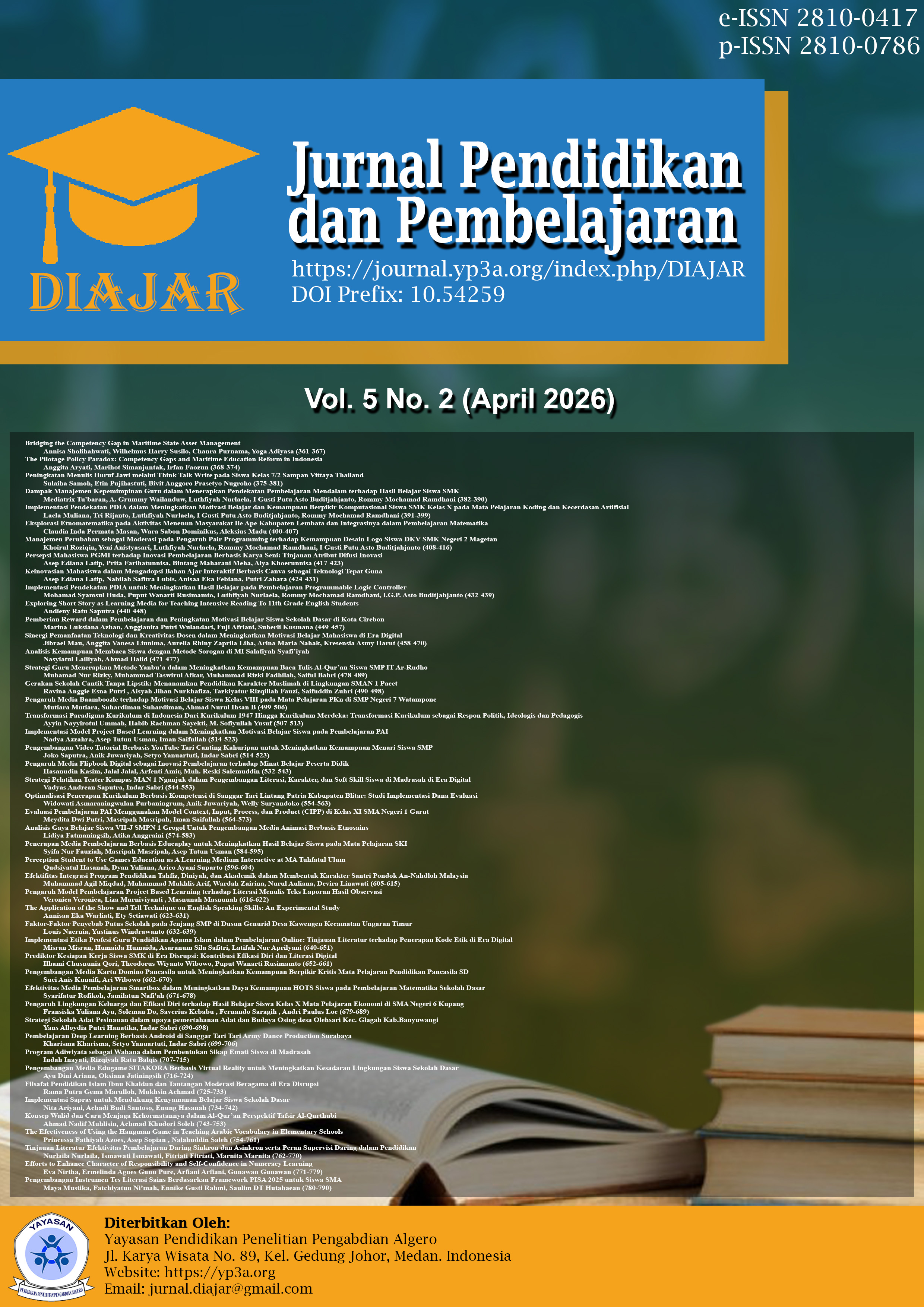
Pengembangan Media Edugame SITAKORA Berbasis Virtual Reality untuk Meningkatkan Kesadaran Lingkungan Siswa Sekolah Dasar
DOI:
https://doi.org/10.54259/diajar.v5i2.6347Kata Kunci:
Edugame, Virtual Reality, Vygotsky's Play Theory, Enviromental AwarnessAbstrak
Increasingly complex environmental issues require effective environmental education from an early age so that children develop sustainable habits and awareness. This study aims to develop and test the effectiveness of the SITAKORA (Simulation of Environmentally Friendly Waste Management) edugame based on Virtual Reality (VR), which is designed using Lev Vygotsky's play theory approach to increase environmental awareness among elementary school students. The research used the Research and Development (R&D) method with the ADDIE model, which includes the stages of Analysis, Design, Development, Implementation, and Evaluation. The results of the needs analysis revealed that students' behavior in disposing of and managing waste was still inconsistent even though their conceptual understanding was adequate. The development process resulted in the SITAKORA VR-based edugame, which was validated by experts with a feasibility score of 89.5%, indicating a highly feasible category. Implementation was carried out at Mulyoagung Elementary School, Bojonegoro, and the evaluation results showed a significant increase in students' environmental awareness scores after using the edugame. The integration of Vygotsky's play theory in the design of VR activities enabled scaffolding and learning interactions that encouraged meaningful play experiences. Thus, the VR-based SITAKORA edugame proved to be effective, engaging, and innovative in increasing environmental awareness and behavior among elementary school children.
Unduhan
Referensi
M. Zainnudin, M. A. Putri, and A. Mayasari, “Environmental learning through the development of virtual reality-based composting modules in elementary schools,” El Midad, vol. 17, no. 2, pp. 301–319, 2025.
T. Y. Chuang, S. K. Tsai, and Y. H. Lu, “Technology-enhanced digital game-based learning for environmental literacy: catalyzing attitude change in learners,” Frontiers in Education, vol. 10, p. 1629670, Sep. 2025.
R. Syahriani, “Revisiting Vygotsky’s Zone of Proximal Development: Misinterpretations and Practical Applications in Education,” in Proc. Int. Conf. Research Issues and Community Service, 2024, pp. 76–83.
V. Y. Erviana and Y. Sepriansyah, “The effectiveness of virtual reality media on primary school students’ learning outcomes,” International Journal of Elementary Education, vol. 8, no. 1, pp. 141–149, 2024.
H. Zhang, Q. Liu, and J. Sun, “Meta-analysis of VR effectiveness in elementary education: Cognitive and affective outcomes,” Educational Psychology Review, vol. 35, no. 2, pp. 361–386, 2023.
N. Sari, A. Prasetyo, and I. Damanik, “Feasibility of 3D virtual reality for enhancing environmental awareness in primary schools,” Education and Information Technologies, vol. 27, no. 3, pp. 4871–4887, 2022.
D. Sulisworo, T. Rahayu, and A. Fitriani, “Enhancing elementary students’ environmental awareness through VR habitat simulation,” Journal of Educational Research and Technology, vol. 5, no. 2, pp. 55–67, 2023.
P. Johnson, Designing Scaffolding for Immersive Virtual Environments: A Conceptual Framework. Springer Education Series in Learning Technologies, 2021.
R. Lim and S. Chan, “Applying ADDIE for immersive VR instructional design,” Educational Technology Research Journal, vol. 71, no. 4, pp. 212–228, 2023.
UCL Learning Lab, Dynamic ADDIE Framework for Virtual Reality Instructional Design: A Research Brief. University College London Repository, 2024.
R. Taylor, “Motivational and behavioural outcomes of VR environmental games: A quasi-experimental study,” Journal of Media in Education, vol. 19, no. 1, pp. 33–49, 2024.
Y. Chen and L. Wang, Virtual Reality Serious Games for Promoting Sustainable Behaviour: A Motivational Approach. Taylor & Francis, 2024.
K. Lee, W. Tan, and H. Chia, “AR/VR in environmental literacy education: A systematic review,” in Proc. Int. Conf. Learning Sciences (ICLS), 2025, pp. 2528–2536.
Z. Zamsiswaya, S. Syawaluddin, and S. Syahrizul, “Pengembangan Model ADDIE (Analysis, Design, Development, Implementation, Evaluation),” Jurnal Pendidikan Tambusai, vol. 8, no. 3, pp. 46363–46369, 2024.
Unduhan
Diterbitkan
Cara Mengutip
Terbitan
Bagian
Lisensi
Hak Cipta (c) 2026 Ayu Dini Ariana, Oksiana Jatiningsih

Artikel ini berlisensi Creative Commons Attribution 4.0 International License.
Hak cipta pada setiap artikel adalah milik penulis.
Penulis mengakui bahwa DIAJAR (Jurnal Pendidikan dan Pembelajaran) sebagai publisher yang mempublikasikan pertama kali dengan lisensi Creative Commons Attribution 4.0 International License.
Penulis dapat memasukan tulisan secara terpisah, mengatur distribusi non-ekskulif dari naskah yang telah terbit di jurnal ini kedalam versi yang lain, seperti: dikirim ke respository institusi penulis, publikasi kedalam buku, dan lain-lain. Dengan mengakui bahwa naskah telah terbit pertama kali pada DIAJAR (Jurnal Pendidikan dan Pembelajaran).









