
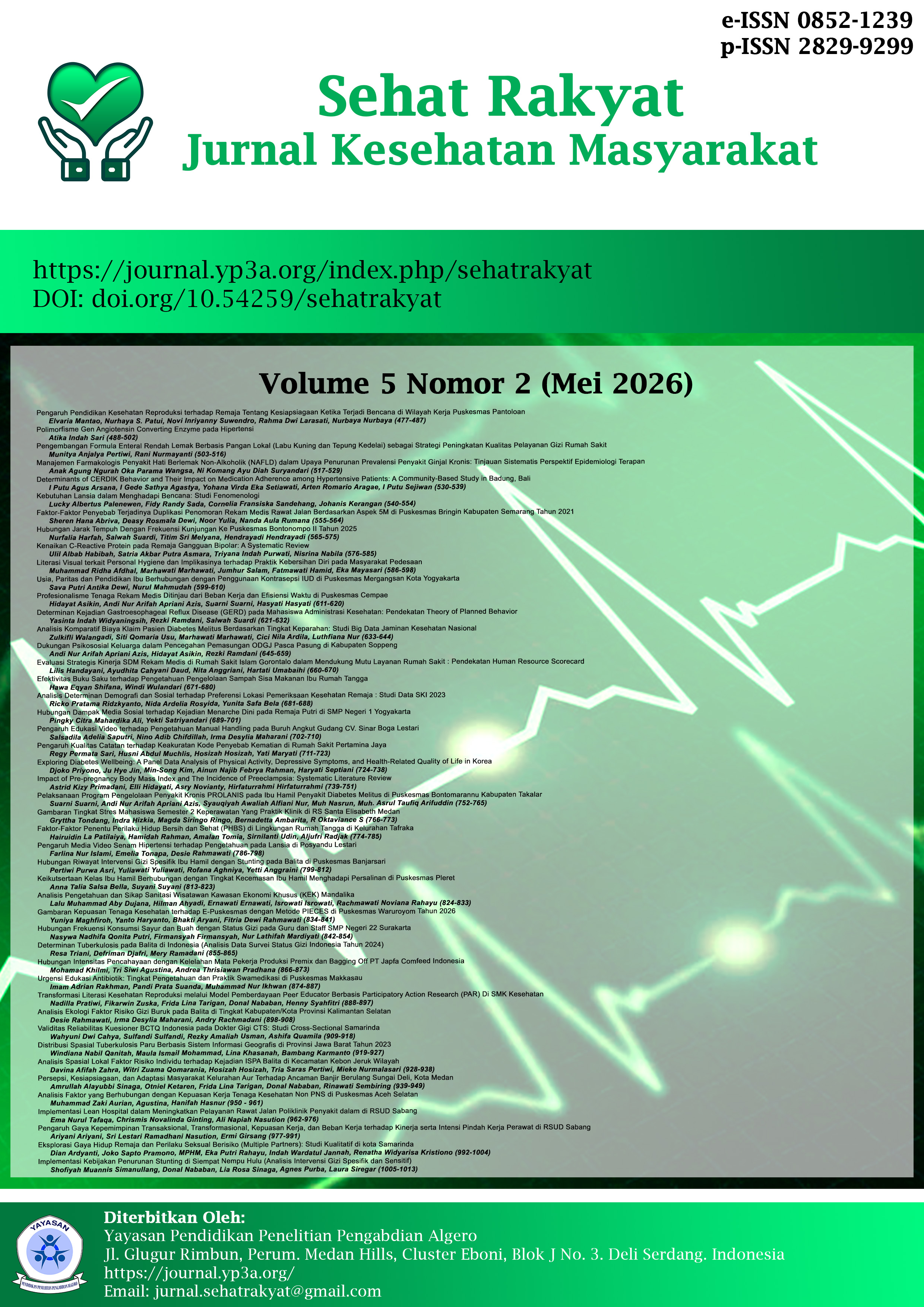
Urgensi Edukasi Antibiotik: Tingkat Pengetahuan dan Praktik Swamedikasi di Puskesmas Makkasau
DOI:
https://doi.org/10.54259/sehatrakyat.v5i2.7590Keywords:
Knowledge, Antibiotics, Antibiotic Resistance, Puskesmas MakkasauAbstract
Background: Antibiotics are essential medicines for treating bacterial infections; however, inappropriate use has become a major driver of the global rise in antibiotic resistance, leading to reduced treatment effectiveness, increased healthcare costs, and higher mortality risk. In Indonesia, resistance to various classes of antibiotics, such as β-lactams and macrolides, has increased significantly in recent years. Prior studies indicate that public knowledge levels substantially contribute to irrational antibiotic use. Puskesmas, as primary healthcare facilities, play a strategic role in education and health promotion regarding prudent antibiotic use. Methods: This descriptive observational study employed a questionnaire to assess patients’ knowledge of antibiotic use at Puskesmas Makkasau. Respondents were selected through convenience sampling, and data were analyzed using frequency distributions to identify knowledge levels. Result: The findings show that most respondents exhibited inadequate knowledge and inappropriate attitudes toward antibiotic use. Conclusion: The majority of visitors to Puskesmas Makkasau had low levels of knowledge about antibiotic use, with persistent misconceptions, such as believing antibiotics cure viral infections; and common practices of sharing, storing, and using antibiotics without a physician’s prescription.
Downloads
References
Adriani, A., 1, Pammusureng, A. I., 2, & Balai Besar Pengawas Obat dan Makanan Makassar. (2025). Gap Analisis Pengelolaan Antibiotik di Apotik dalam Wilayah Pengawasan BBPOM di Makassar Periode Januari 2024 – Juni 2025. In Jurnal Novem Medika Farmasi (pp. 01–13).
Alharbi, S. R., Alzamil, L., Alkudmani, Z. S., Alhani, A., Faqih, L., & Aldawood, E. (2025). Knowledge and misconceptions about antibiotic use and resistance among dental clinic visitors in Saudi Arabia—A Cross-Sectional Study. Healthcare, 13(16), 1971. https://doi.org/10.3390/healthcare13161971
Budiman and Riyanto A (2013) Kapita Selekta Kuisioner Pengetahuan Dan Sikap Dalam Penelitian Kesehatan. Jakarta: Salemba Medika.
Collignon, P., Athukorala, P.C., Senanayake, S. & Khan, F. (2018) 'Antibiotic resistance: What the developing world needs to learn from developed countries', Globalization and Health, 14(1), p. 57.
Dube, K., Knight, S., Van den Heever, D. & Hugo, J. (2022) 'Factors associated with inappropriate antibiotic use in primary healthcare settings in South Africa', BMC Infectious Diseases, 22(1), p. 234.
Eggermont, D., Smit, M.A.M., Kwestroo, G.A., Verheij, R.A., Hek, K. and Kunst, A.E. (2018). The influence of gender concordance between general practitioner and patient on antibiotic prescribing for sore throat symptoms: a retrospective study. BMC Family Practice, 19(1). doi:https://doi.org/10.1186/s12875-018-0859-6.
Habboush, Y. and Guzman, N. (2023). Antibiotic Resistance. [online] National Library of Medicine. Available at: https://www.ncbi.nlm.nih.gov/books/NBK513277/.
Hamedani, M., Hoveidamanesh, S., Koohpayehzadeh, J., Arabi, M., & Divsalar, F. (2023). Relationship between Health Literacy and Proper Antibiotic Use Awareness in Tehran 2019–2020. In Medical Journal of the Islamic Republic of Iran (Vol. 37, p. 133). https://doi.org/10.47176/mjiri.37.133
Jamhour, A., El-Kheir, A., Salameh, P., Hanna, P. A., & Mansour, H. (2017). Antibiotic knowledge and self-medication practices in a developing country: A cross-sectional study. American Journal of Infection Control, 45(4), 384–388. https://doi.org/10.1016/j.ajic.2016.11.026
Kementerian Kesehatan Republik Indonesia (2022) Laporan Nasional Pengendalian Resistensi Antibiotik. Jakarta: Kementerian Kesehatan RI.
Lim, J. M., Duong, M. C., Cook, A. R., Hsu, L. Y., & Tam, C. C. (2021). Public knowledge, attitudes and practices related to antibiotic use and resistance in Singapore: a cross-sectional population survey. BMJ Open, 11(9), e048157. https://doi.org/10.1136/bmjopen-2020-048157
Mabilika, R. J., Mpolya, E., & Shirima, G. (2022). Prevalence and predictors of self-medication with antibiotics in selected urban and rural districts of the Dodoma region, Central Tanzania: a cross-sectional study. Antimicrobial Resistance and Infection Control, 11(1), 86. https://doi.org/10.1186/s13756-022-01124-9
Mallah, N., Orsini, N., Figueiras, A., & Takkouche, B. (2022). Education level and misuse of antibiotics in the general population: a systematic review and dose–response meta-analysis. Antimicrobial Resistance and Infection Control, 11(1), 24. https://doi.org/10.1186/s13756-022-01063-5
Maulana, H., Suryani, T. & Pratama, A. (2023) ‘Tingkat Pengetahuan Masyarakat tentang Penggunaan Antibiotik di Lombok Timur’, Jurnal Ilmu Kesehatan Masyarakat, 11(3), pp. 45-52.
Marsudi, A. (2022). Tingkat Pengetahuan dan Perilaku Masyarakat Terhadap Penggunaan Antibiotik di Beberapa Apotek di Kota Ternate. Jurnal Farmasi Medica/Pharmacy Medical Journal (PMJ), 4(2), p.54. doi:https://doi.org/10.35799/pmj.v4i2.34766.
Nuha, L., & Zuhroh, D. F. (2025). Hubungan Umur Pengguna dengan System Quality pada SIMRS di RS Muhammadiyah Cabang Sepanjang. In Journal of Public Health Science Research (Vol. 5, No. 2, pp. 1–13).
O'Neill, J. (2016) Tackling drug-resistant infections globally: Final report and recommendations. The Review on Antimicrobial Resistance.
Pavydė, E., Veikutis, V., Mačiulienė, A., Mačiulis, V., Petrikonis, K., & Stankevičius, E. (2015). Public Knowledge, Beliefs and Behavior on Antibiotic Use and Self-Medication in Lithuania. International Journal of Environmental Research and Public Health, 12(6), 7002–7016. https://doi.org/10.3390/ijerph120607002
Prasetyoputri, A., Jarrad, A.M., Cooper, M.A. and Blaskovich, M.A.T. (2019). The Eagle Effect and Antibiotic-Induced Persistence: Two Sides of the Same Coin? Trends in Microbiology, [online] 27(4), pp.339–354. doi:https://doi.org/10.1016/j.tim.2018.10.007.
S.A. Novianti, D., Apt, MM, Apt, M.BioMed Magdalene, D. E. S., Apt, MPH S.Si, R., S.Farm, Apt Lesmana, C., S.Farm, Apt Fitrianyah, A., S.Si, Apt Syamsuddin, F., S.Farm, Apt Machdiawati, R., S.Farm, Apt Rejeki, T. R., S.Farm, M.Farm.Klin.Apt Trisnadewi, I. G. A., S.Farm, Apt Liretha, D., S.Farm, Apt Adiningsih, U. T., Herlambang, A., Apt Prayitno, Dr. A., S.F., Apt Hermalia, Rd., Apt, M.Si S.Si, N. F., S.Farm, Apt Qalsum, U., & Wibo, P. (2020). Pedoman pelaksanaan Program Gerakan Masyarakat Cerdas Menggunakan Obat (GEMA CERMAT). Kementerian Kesehatan RI.
Widayati, A., Suryawati, S. & Hakimi, M. (2021) ‘Pengetahuan Masyarakat terhadap Antibiotik di Yogyakarta: Sebuah Studi Observasional’, Jurnal Kesehatan Indonesia, 8(1), pp. 15-20.
World Health Organization (WHO) (2020) Antimicrobial resistance: Global report on surveillance.
World Health Organization (WHO) (2023) Antibiotic resistance: Overview and prevention strategies.
Downloads
Published
How to Cite
Issue
Section
License
Copyright (c) 2026 Imam Adrian Rakhman, Pandi Prata Suanda, Muhammad Nur Ikhwan

This work is licensed under a Creative Commons Attribution 4.0 International License.
Hak cipta pada setiap artikel adalah milik penulis.
Penulis mengakui bahwa SEHATRAKYAT (Jurnal Kesehatan Masyarakat) sebagai publisher yang mempublikasikan pertama kali dengan lisensi Creative Commons Attribution 4.0 International License.
Penulis dapat memasukan tulisan secara terpisah, mengatur distribusi non-ekskulif dari naskah yang telah terbit di jurnal ini kedalam versi yang lain, seperti: dikirim ke respository institusi penulis, publikasi kedalam buku, dan lain-lain. Dengan mengakui bahwa naskah telah terbit pertama kali pada SEHATRAKYAT (Jurnal Kesehatan Masyarakat).






