
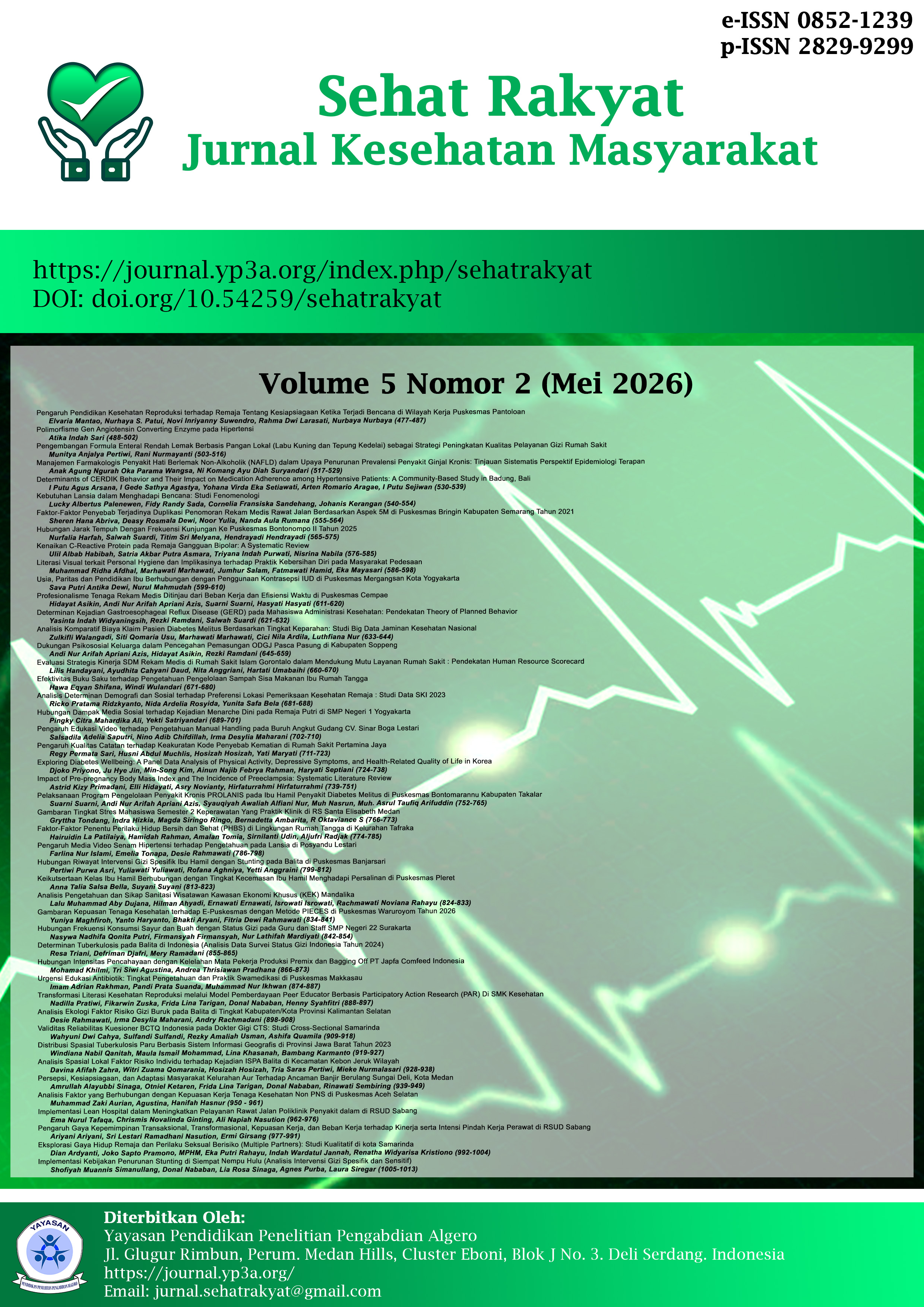
Persepsi, Kesiapsiagaan, dan Adaptasi Masyarakat Kelurahan Aur Terhadap Ancaman Banjir Berulang Sungai Deli, Kota Medan
DOI:
https://doi.org/10.54259/sehatrakyat.v5i2.7764Keywords:
Perception, Preparedness, Adaptation, Flooding, Deli RiverAbstract
This research aims to analyze the perception, preparedness, and adaptation strategies of the community residing along the Deli Riverbanks in Aur Village, Medan, against the threat of recurring floods. This area is a densely populated settlement with high vulnerability to annual river overflows. The study employs a descriptive qualitative approach, with data collected through in-depth interviews with 11 informants, field observations, and documentation. The results indicate that community perception has undergone risk normalization, where small-scale flooding is perceived as a natural seasonal routine, thereby decreasing emotional vigilance. Regarding preparedness, the study reveals an absence of a formal Early Warning System (EWS) and limited standard evacuation equipment. However, the community has developed informal preparedness based on local knowledge and observations of natural signs. Adaptation strategies are implemented structurally through the construction of two-story or stilt houses and socially through the strengthening of social capital in the form of inter-neighbor solidarity and mutual cooperation (gotong royong) practices. This study concludes that community resilience in Aur Village is primarily supported by collective experience and strong social bonds rather than formal government infrastructure support.
Downloads
References
Ahmad Sabir. (2016). Persepsi sosial masyarakat terhadap bencana banjir. Jurnal Ilmu Ekonomi dan Sosial, 7(2), 123-135. https://doi.org/10.35724/jies.v7i2.502
Asrofi, A., Sutikno, & Hidayah, N. (2017). Analisis adaptasi masyarakat terhadap bencana banjir di daerah perkotaan. Jurnal Teknik Sipil dan Perencanaan, 19(2), 85–94. https://doi.org/10.15294/jtsp.v19i2.11520
Badan Nasional Penanggulangan Bencana (BNPB). (2024). Data Bencana Indonesia 2024. Jakarta: Pusat Data Informasi dan Komunikasi Kebencanaan BNPB.
Bappenas. (2020). Rencana Aksi Pemulihan Infrastruktur Pasca-Bencana. Jakarta: Kementerian PPN/Bappenas.
BMKG. (2024). Sistem Peringatan Dini Bencana Hidrometeorologi di Indonesia. Jakarta: BMKG.
BPBD Kota Medan. (2022). Laporan Kaji Cepat Banjir Kota Medan 2022. Medan: BPBD Kota Medan.
BPS. (2024). Statistik Bencana Alam Indonesia Tahun 2024. Jakarta: Badan Pusat Statistik.
CRED & UNDRR. (2020). The Human Cost of Disasters: An Overview of the Last 20 Years (2000–2019). Geneva: UNDRR.
Eristiawan, D., & Suharini, A. (2021). Strategi adaptasi non-struktural dalam mitigasi bencana di Indonesia. Jurnal Ketahanan Bencana, 7(1), 11–23. https://doi.org/10.22146/jkb.65432
Fahreza, A., Lubis, S., & Siregar, R. (2024). Adaptasi sosial-ekonomi masyarakat di wilayah rawan banjir Kelurahan Hamdan Kota Medan. Socius: Jurnal Penelitian Ilmu-Ilmu Sosial, 8(2), 55–67. https://doi.org/10.51178/socius.v8i2.1824
Fahri, M., Ningsih, A., & Handayani, D. (2018). Persepsi risiko dan perilaku adaptif masyarakat terhadap bencana banjir di wilayah perkotaan. Jurnal Ilmu Sosial dan Kebencanaan, 4(1), 45–58. https://doi.org/10.24815/jisk.v4i1.10234
Habiba, U., Shaw, R., & Takeuchi, Y. (2017). Farmer‘s perception and adaptation practices to flooding: A case study from Bangladesh. Natural Hazards, 84(3), 1737–1755. https://doi.org/10.1007/s11069-016-2507-z
Habibi, M., et al. (2022). Perception of health risks and adaptation behavior in flood-prone urban settlements. Journal of Public Health and Environmental Health, 12(3), 45-56. [Sinkronisasi Pembahasan]
Hidayati, D. (2022). Manajemen Risiko Bencana Hidrometeorologi di Indonesia. Jakarta: Pusat Mitigasi Bencana UI Press.
IPCC. (2022). Climate Change 2022: Impacts, Adaptation, and Vulnerability. Cambridge University Press. https://doi.org/10.1017/9781009325844
Moleong, L. J. (2021). Metodologi Penelitian Kualitatif (Edisi Revisi). Bandung: PT Remaja Rosdakarya.
Myrnawati. (2018). Instrumen Penelitian dalam Metodologi Kualitatif. Jakarta: Penerbit Mitra Wacana Media.
Nur Asiah, Sitohang, N. A., Karo, E. I. B., & Adela, C. A. (2023). Pengetahuan remaja tentang implementasi mitigasi bencana pada kelompok rentan di Kelurahan Aur Kecamatan Medan Maimun. Jurnal Riset Hesti Medan, 8(1), 45-52. https://doi.org/10.34008/jurhesti.v8i1.312
Pahrul Razikin, N., & Syahputra, D. (2017). Penanggulangan bencana berbasis persepsi masyarakat. Jurnal Pendidikan Geografi, 22(3), 210–219. https://doi.org/10.17977/um017v22i3p210-219
Paton, D., & Johnston, D. (2017). Disaster resilience: An integrated approach (2nd ed.). Springfield: Charles C Thomas Publisher.
Qanitah, S., Napitupulu, R. P. M., Manullang, C., & Siregar, H. (2024). Analisis manajemen bencana banjir di Kampung Aur. Jurnal Triwikrama: Ilmu Sosial, 3(4), 112-125. https://doi.org/10.55712/triwikrama.v3i4.105
Saputra, R., & Rodiyah, R. (2022). Pendidikan kebencanaan sebagai upaya peningkatan kesiapsiagaan masyarakat terhadap banjir. Jurnal Ketahanan Nasional, 28(1), 55–66. https://doi.org/10.22146/jkn.71234
Sutanto, & Taufik, H. (2020). Analisis bencana hidrometeorologi di Indonesia: Tren dan tantangan. Jurnal Meteorologi dan Klimatologi, 17(1), 1–12. https://doi.org/10.31227/osf.io/8j9v2
UNDRR. (2021). Global Assessment Report on Disaster Risk Reduction 2021. Geneva: United Nations Office for Disaster Risk Reduction. https://www.undrr.org/gar2021
World Bank. (2021). Resilient cities: Building resilience to natural disasters in developing countries. Washington, D.C.: The World Bank. https://openknowledge.worldbank.org/handle/10986/35402
World Risk Report. (2022). World risk report 2022. Bündnis Entwicklung Hilft.
Downloads
Published
How to Cite
Issue
Section
License
Copyright (c) 2026 Amrullah Alayubbi Sinaga, Otniel Ketaren, Frida Lina Tarigan, Donal Nababan, Rinawati Sembiring

This work is licensed under a Creative Commons Attribution 4.0 International License.
Hak cipta pada setiap artikel adalah milik penulis.
Penulis mengakui bahwa SEHATRAKYAT (Jurnal Kesehatan Masyarakat) sebagai publisher yang mempublikasikan pertama kali dengan lisensi Creative Commons Attribution 4.0 International License.
Penulis dapat memasukan tulisan secara terpisah, mengatur distribusi non-ekskulif dari naskah yang telah terbit di jurnal ini kedalam versi yang lain, seperti: dikirim ke respository institusi penulis, publikasi kedalam buku, dan lain-lain. Dengan mengakui bahwa naskah telah terbit pertama kali pada SEHATRAKYAT (Jurnal Kesehatan Masyarakat).






